The public disclosure of PHP2Shell , a pair of critical Remote Code Execution (RCE) vulnerabilities tracked as CVE-2026-109618 and CVE-2026-109619 last week placed millions of web servers, Content Management Systems and internet-facing applications at immediate risk.
Rated 9.2 (Critical) under CVSS v4.0, these flaws exist in PHP’s core engine across versions 5.4 through 8.5.11 and allow unauthenticated attackers to execute arbitrary code with a single crafted web request.
For MSPs and IT security teams, identifying every exposed asset across diverse client environments is an urgent priority. Guardz provides immediate visibility into PHP2Shell exposures through automated External Footprint Scans and continuous posture monitoring, helping MSPs pinpoint vulnerable technologies before threat actors exploit them.
Why MSPs Must Act Immediately
The public disclosure of PHP2Shell, a pair of critical Remote Code Execution (RCE) vulnerabilities tracked as CVE-2026-109618 and CVE
– Pre-Authentication Exploitation: Malicious requests with oversized payloads can trigger OOM corruption before a CMS (such as WordPress, Drupal, or Joomla) or web application ever checks user credentials.
– Shadow & Embedded PHP Instances: Beyond primary corporate websites, PHP often powers secondary subdomains, monitoring portals (such as Zabbix), and legacy web apps running End-of-Life (EOL) PHP branches like 8.0.x or 7.4.x.
– Active In-the-Wild Exploitation: Threat intelligence telemetry confirmed active exploitation attempts days prior to the official patch release, making rapid discovery and remediation critical.
How Guardz Detects PHP2Shell Across Your Client Base
Guardz eliminates the guesswork of manual asset auditing by continuously mapping and scanning your clients’ external attack surfaces and endpoint postures within a unified Detection & Response console.
Automated External Footprint Scanning
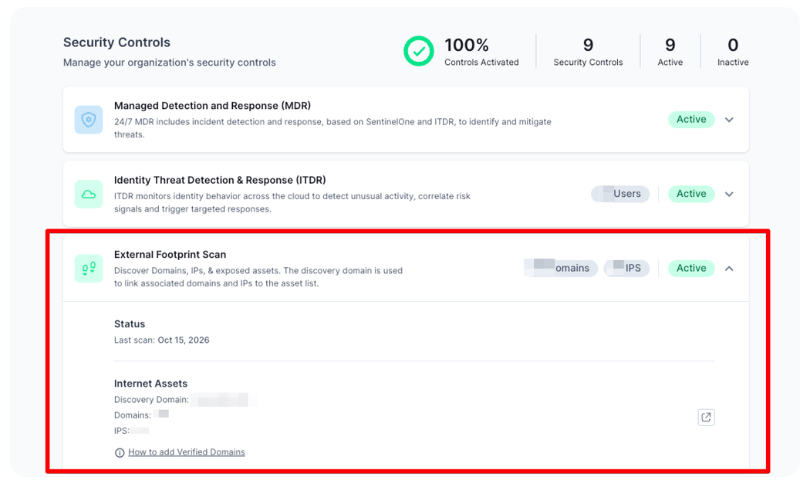
Guardz’s External Footprint Scan automatically discovers internet-facing domains, subdomains, and web servers across all managed tenants, fingerprinting the underlying technology stack to identify unpatched PHP versions.
When an exposed domain runs a vulnerable PHP build (such as PHP 8.0.27), Guardz immediately flags a Critical severity issue under Vulnerable Technologies (Vulnerable Technologies Web App Critical or Vulnerable Technologies General Critical):
– Granular Asset & Version Mapping: Within the Issue Overview panel, Guardz pinpoints the exact affected domain (e.g., primary web domains or specific subdomains like zabbix.*) alongside the detected PHP version.
– Direct CVE Correlation: Guardz automatically enriches existing and newly discovered technology findings by appending CVE-2026-109618 and CVE-2026-109619 directly to the asset’s vulnerability profile alongside historical CVEs.
Navigating to Vulnerable Technology Alerts
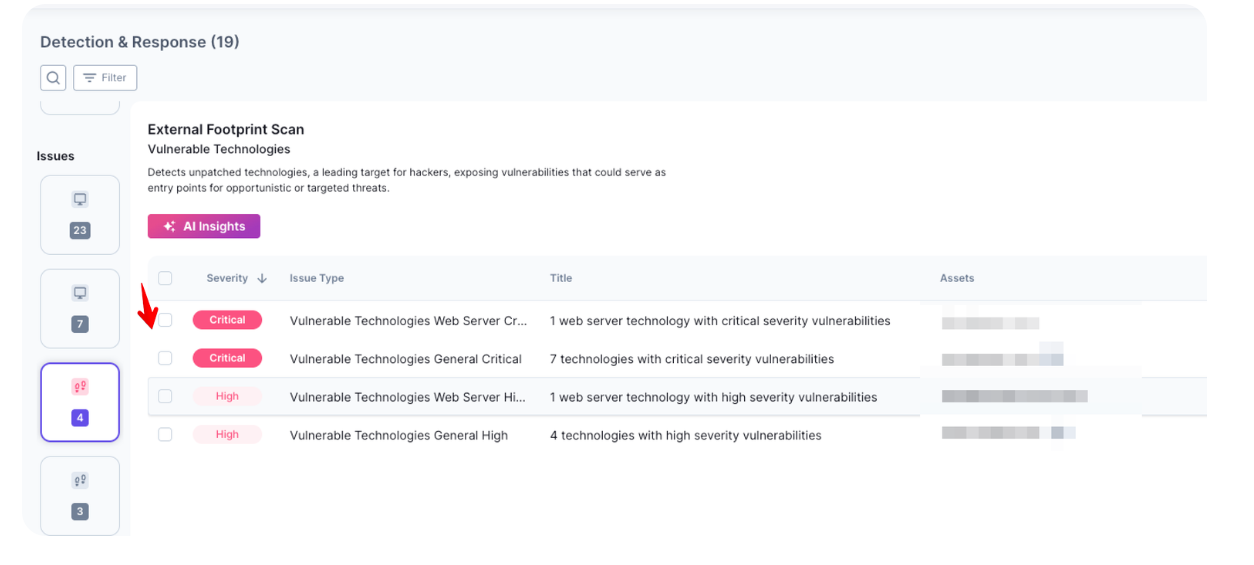
Displays the main Guardz Detection & Response console filtered for External Footprint Scan issues. Highlights high-priority critical alerts in red, indicating web server technologies that require immediate review.
Identifying Critical Vulnerable Technologies
– Located directly after the summary of direct CVE correlation.
– Focuses on the summary table within External Footprint Scan results. Pinpoints rows flagged as Critical (indicated by the red arrow), helping operators distinguish active vulnerability threats from low-severity warnings.
Inspecting Asset & CVE Correlation Details
– Located before the Resurfacing Ignored or Dormant Risks section.
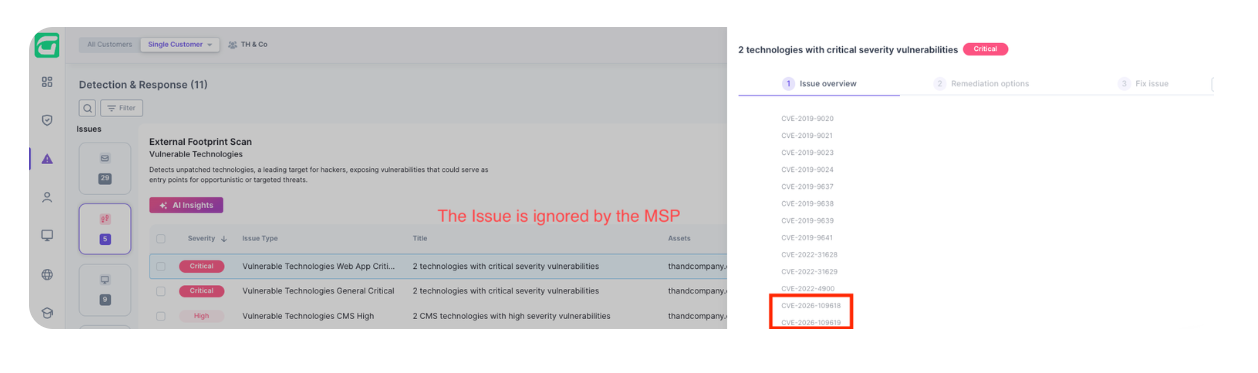
– Demonstrates the Issue Overview side panel for a specific asset. Shows how Guardz enriches asset findings by displaying exact domain names alongside specific CVE designations (CVE-2026-109618 and CVE-2026-109619).
Remediation & Status Verification
– Located above the step-by-step remediation guide.
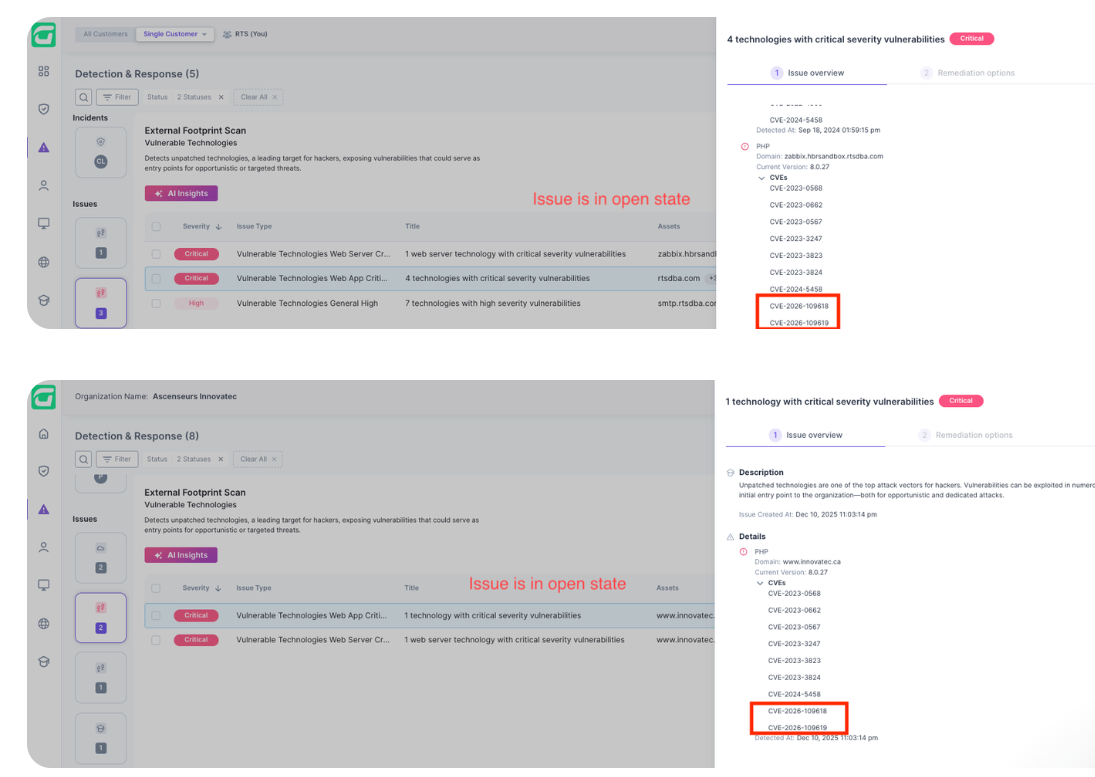
– Illustrates the workflow for applying fixes and verifying that vulnerable PHP instances have been properly updated or remediated across managed environments.
Step by Step Remediation Workflow for MSPs
To protect your clients from PHP2Shell using Guardz, follow this structured response workflow:
- Audit Open & Ignored External Footprint Issues: Navigate to Detection & Response > Issues > External Footprint Scan in your Guardz dashboard. Filter by Status to review both Open and Ignored issues for Vulnerable Technologies Web App Critical and Vulnerable Technologies General Critical.
- Inspect Asset Details for CVE-2026-109618 & CVE-2026-109619: Click into flagged assets to open the Issue Overview drawer. Check the PHP details section to see the exact domain, current PHP version, and the presence of CVE-2026-109618 and CVE-2026-109619.
- Upgrade PHP to Patched Releases: Follow the Remediation options and Fix issue workflows in Guardz. Update affected servers immediately to PHP 8.2.35, 8.3.36, 8.4.27, or 8.5.12. For End-of-Life PHP Versions (e.g., PHP 8.0.27 or 8.1): Upgrade the server to a supported PHP branch (8.2+), or apply vendor-supplied backported patches from your Linux distribution (such as Ubuntu, Debian, Red Hat, or CloudLinux/cPanel).
- Restart PHP Workers and Rebuild Containers: Updating packages alone is not enough PHP continues running vulnerable code in memory until worker processes restart. Restart php-fpm or Apache (mod_php), and rebuild/redeploy any containerized PHP workloads.
- Verify Endpoint & Identity Hygiene: Review Endpoint Posture and Identity Threat Detection & Response (ITDR) alerts in Guardz to ensure no unauthorized administrative accounts, unexpected shell processes, or lateral movement occurred prior to patching.
Action required: PHP2Shell critical PHP vulnerabilities
Guardz MDR is tracking PHP2Shell, two critical CVSS 9.2 flaws allowing unauthenticated RCE before credentials are checked. Active exploitation confirmed.
Immediate Steps:
– Verify Posture: Review Endpoint Posture and ITDR alerts for post-exploitation activity.
– Audit Assets: Go to Detection & Response > Issues > External Footprint Scan to check for Vulnerable Technologies Web App/General Critical alerts.
– Upgrade PHP: Update servers immediately to 8.2.35, 8.3.36, 8.4.27, or 8.5.12 (or apply vendor backported patches for EOL versions).
Restart Workers: Restart php-fpm or Apache (mod_php) and rebuild containers to clear memory.
Resurfacing Ignored or Dormant Risks
A common challenge for MSPs is managing “alert fatigue” around legacy web servers where older vulnerabilities may have been previously deprioritized or ignored.
– Catching Overlooked Exposures: Even if an unpatched web technology issue was previously ignored by an MSP or left in an open state from an earlier scan, Guardz dynamically updates the CVE inventory on that asset to include CVE-2026-109618 and CVE-2026-109619.
– AI Insights & Prioritization: Guardz provides AI Insights directly within the Detection & Response view, helping security teams cut through the noise, evaluate the heightened severity of newly weaponized CVEs, and prioritize immediate remediation across multi-tenant environments.
Comprehensive Endpoint Posture & Defense
If an attacker exploits a public-facing web server via PHP2Shell, they often next deploy web shells, harvest credentials, or move laterally across the network. Guardz’s Endpoint Protection and Endpoint Posture monitoring provide a crucial second layer of defense by continuously verifying antivirus status, OS updates, firewall configurations, and disk encryption across managed devices, ensuring that endpoints remain hardened against post-exploitation activity.
Access Guardz' PHP2Shell Vulnerability quick fix guide here: https://guardz.com/blog/quick-fix-guide-php2shell-vulnerability/
.
Was this article helpful?
That’s Great!
Thank you for your feedback
Sorry! We couldn't be helpful
Thank you for your feedback
Feedback sent
We appreciate your effort and will try to fix the article